
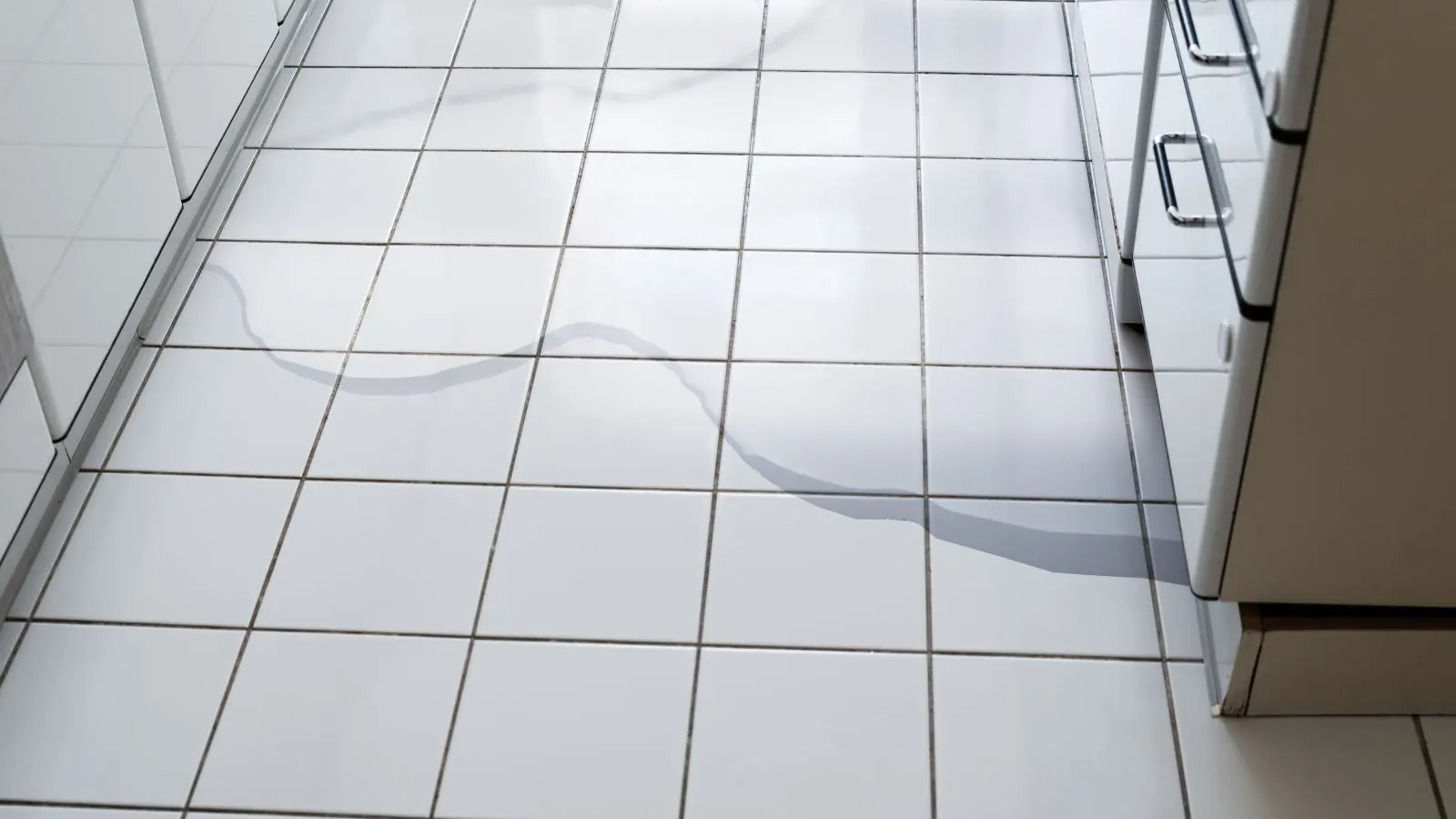
Why kitchen leaks do so much hidden damage
Kitchens have more water sources than most rooms. The sink has two supply lines, a drain and often a disposal. The dishwasher has a supply line, a drain hose and a door seal. The refrigerator may feed an ice maker. Add a faucet, a filter and a pot filler, and there are many places to fail.
The layout makes leaks hard to see. Water runs under cabinets, soaks the toe-kick, wicks into the base and seeps under the flooring. By the time the floor looks wet at the edge, the base of the cabinets, the subfloor and the wall behind are usually wet too.
DeSoto buys its drinking water from the City of Dallas, according to city water information, and the supply lines in a kitchen hold steady pressure. A small weep at a shutoff valve can run for months and swell the base of a particleboard cabinet before anyone smells anything. For leaks that start at a machine, the appliance leak water damage page covers the machine side.
What you see and what it means
| What you see | What it usually means | What to do |
|---|---|---|
| Water on the floor near the sink | Supply line, drain or faucet leak | Close the valves under the sink |
| Swollen or soft cabinet base | Water wicking into particleboard | Photograph and call (972) 945-2885 |
| Lifting laminate or tile edges | Water under the floor | Stay off the area and call |
| Musty smell under the sink | Slow leak | Check for damp spots and call for a moisture check |
| Stain on the ceiling below an upstairs kitchen | Water has gone through the subfloor | Keep clear and place a bucket |
First-hour safety steps in a wet kitchen
Close the valves
Shut the supply valves under the sink or behind the machine. If you cannot find them, close the main.
Power first
Turn off the breaker for the kitchen circuits if water is near outlets or appliances. Unplug only on dry ground.
Lift and protect
Move food, small appliances and cabinet contents out of the wet area.
Call for help
Call (972) 945-2885. Call a plumber for the failed line. Both are usually needed.
How crews restore a wet kitchen
Crews begin by extracting the water and checking the cabinets and floor with a moisture meter. A thermal imaging camera shows wet zones behind cabinet faces and under the toe-kick. Toe-kicks and sometimes cabinet backs are removed so the base can dry.
Solid wood cabinets often dry in place. Particleboard bases that swelled generally do not recover, so they are often replaced. Flooring depends on the type. Tile usually dries, laminate swells, and hardwood may cup. The hardwood floor water damage repair page covers wood floors.
Air movers and dehumidifiers run until readings meet the dry standard, following the ANSI/IICRC S500 reference. Countertops are usually left in place and protected. Rebuilding cabinets, flooring and paint follows on the water damage repair page.
Leak in the kitchen?
Close the valve under the sink and call. A dispatcher answers at any hour and explains the plan.
What changes the cost of kitchen water damage
- Cabinet material. Particleboard often needs replacement, while solid wood can dry
- Flooring layers. Tile over backer board dries differently than laminate
- Wall cavities. Water behind the sink wall adds drywall and insulation work
- Time before drying. Days of wet base material means deeper damage
- Appliances. Pulling a refrigerator or range adds time
- Rebuild scope. Cabinets and counters make a rebuild larger than most rooms
Insurance and kitchen leaks
Under the framework the Texas Department of Insurance publishes, a sudden and accidental release of water is commonly covered and a continuous leak typically is not. A burst supply line is sudden. A drip under the sink that ran for months is treated differently, so the dates and photographs matter.
Photograph the damage before anything is moved and keep the failed part. DeSoto Building Inspections says a permit is required to alter or repair a building, so ask the city at 972-230-9610 whether replacing plumbing or electrical work needs one before walls close.
Mistakes to avoid after a kitchen leak
- Wiping and moving on. Water under the cabinets stays there
- Caulking over a swollen base. It traps moisture
- Running the dishwasher again. A failed hose can fail again
- Pulling cabinets yourself. Plumbing and wiring may be attached
- Keeping food in a wet fridge area. Power may be off
Where we respond for kitchen losses
Crews work across DeSoto and reach Cedar Hill and Lancaster. If the leak ran under the floor, see structural drying and dehumidification, and for standing water see emergency water removal.
Is emergency kitchen water damage repair available in DeSoto?
Yes, when water is active or spreading. Call (972) 945-2885 at any hour and a crew is sent based on availability to extract water and open the toe-kicks.
Close the valve first and call a plumber for the failed line.
Can wet cabinets be saved?
Solid wood often can, if dried quickly. Particleboard that swelled usually cannot.
A moisture meter shows what can stay.
How do I know if water is under my kitchen floor?
Look for lifting edges, a soft spot, a musty smell or a stain below an upstairs kitchen. A moisture meter confirms it.
Do not seal or cover the floor until it is checked.
Does insurance cover a kitchen leak?
Often when the leak was sudden and accidental. Slow leaks are typically handled differently.
Check your policy and take photographs first.
Will you remove countertops?
Usually not. Countertops are protected and left in place unless the base has to come out.
The crew explains the plan before work starts.